Star Ceilings for Home Cinemas: Fibre Optic, LED and What It Costs

A star ceiling is one of the most requested features in a home cinema, and for good reason. When the lights go down and a field of stars appears overhead, the room changes character completely. It is also one of the easiest features to get wrong. A badly planned star ceiling can be distracting during a film, block Dolby Atmos speakers, or hum from a noisy light source.
This guide explains how star ceilings work and the difference between fibre optic and LED systems. It also covers how to combine a star ceiling with acoustic treatment and overhead speakers, what affects the cost, and the planning decisions that make the difference between a gimmick and a finish that still looks special years later.
What is a star ceiling?
A star ceiling is a ceiling fitted with hundreds or thousands of tiny points of light that recreate a night sky. Most cinema star ceilings use fibre optic strands, each ending in a single “star”. The light comes from a light source hidden outside the ceiling. LED star panels, which have tiny LEDs built into the panel itself, are a simpler alternative.
In a cinema, the star ceiling is normally part of the lighting system. It is dimmed or switched off for the film itself, and used for the moments before and after, and for intermissions.
Fibre optic vs LED star ceilings
Fibre optic star ceilings
Fibre optic is the traditional and still the most refined approach. Each star is the end of a fibre optic strand, pushed through the ceiling panel and trimmed flush. The other ends of the strands are bundled together and lit by a light source, often called a light engine or illuminator, which sits away from the ceiling.
The advantages:
- Variety. Fibres can be different diameters, so stars vary in brightness, just like a real night sky. The best ceilings mix several sizes and cluster them in natural-looking patterns or real constellations.
- No heat or electrics in the ceiling. The fibres carry only light, which makes them suitable for upholstered or fabric ceilings.
- Effects. Light engines can add a gentle twinkle, slow colour changes, or even occasional shooting stars.
- Longevity. The fibres themselves have no electronics to fail. If the light source ever needs replacing, it can be swapped without touching the ceiling.
LED star ceiling panels
LED panels have tiny LEDs set into the panel, wired to a driver. They are quicker to install and usually cheaper. But the stars tend to be more uniform in size and brightness, and they can look more artificial up close. They suit media rooms, playrooms and spaces where budget matters more than realism.
Which is right for a home cinema?
For a dedicated cinema, especially with a dark, upholstered interior, fibre optic almost always gives the more convincing result. LED panels can work well in a multi-use media room, a snug, or a child’s room.
Star ceilings and Dolby Atmos speakers
This is the planning issue most often overlooked. A Dolby Atmos cinema uses overhead speakers in the ceiling, typically four or six of them in our cinemas. A star ceiling covers the same space. The two have to be designed together.
There are two main approaches:
- Speakers hidden behind an acoustically transparent star ceiling. The ceiling is built from fabric-wrapped panels that let sound pass through, with fibres threaded through the fabric. The speakers sit invisibly above. This gives the cleanest finish, but it needs careful coordination between the ceiling, speaker positions and acoustic design.
- Speakers set into the ceiling with stars around them. The star pattern is planned around the speaker positions, and the grilles are finished to blend in. This is simpler, but less invisible.
Either way, the speaker positions should be fixed first, following Dolby’s guidance for the room. The star ceiling is then designed around them, not the other way round. Our guide to home cinema room size and layout explains how speaker positions are worked out.
Star ceilings and acoustic treatment
A cinema ceiling often has an acoustic job to do too. It controls reflections and, in many rooms, absorbs sound to keep dialogue clear. Fabric-wrapped star panels can include absorbent material behind the fabric. So the ceiling can contribute to the room’s acoustic treatment rather than working against it.
Hard plasterboard ceilings painted black with fibres through them look good, but add nothing acoustically. If your cinema’s acoustic design relies on ceiling absorption, the star ceiling needs to be built to provide it. Our guide to home cinema acoustic treatment explains where treatment goes and why.
Getting the details right
Keep the light source quiet and accessible
Fibre optic light engines contain a lamp or LED and, often, a cooling fan. In a quiet cinema, a fan in the ceiling void is audible during quiet scenes. The light engine should be installed outside the room where possible, in a plant room, cupboard or loft, with access for maintenance.
Control it with the rest of the lighting
A star ceiling should be part of the cinema’s lighting scenes, not on its own remote. Pressing “Movie” should fade the stars down with the other lights. “Intermission” should bring them back up gently. Most light engines can be controlled from professional lighting and control systems.
Avoid spill on the screen
Stars are small, but a bright ceiling can still lift the black level on a projection screen, especially near the screen wall. The stars should be dimmed or off during the film. Many designs also leave the area closest to the screen free of stars.
Plan the pattern
Random, evenly spaced stars look artificial. The most convincing ceilings vary star size and density, cluster stars into a “milky way”, or recreate a specific constellation or the night sky on a meaningful date. Decide this at the design stage, because the pattern is set when the fibres are installed.
Think about the whole room
A star ceiling works best as part of a complete lighting design: step lights, wall lights, coffers and backlit panels, all controlled together. It should not be the only feature in the room.
Star ceilings in our cinema projects
Fibre optic star ceilings feature in many of our cinemas. A few examples:
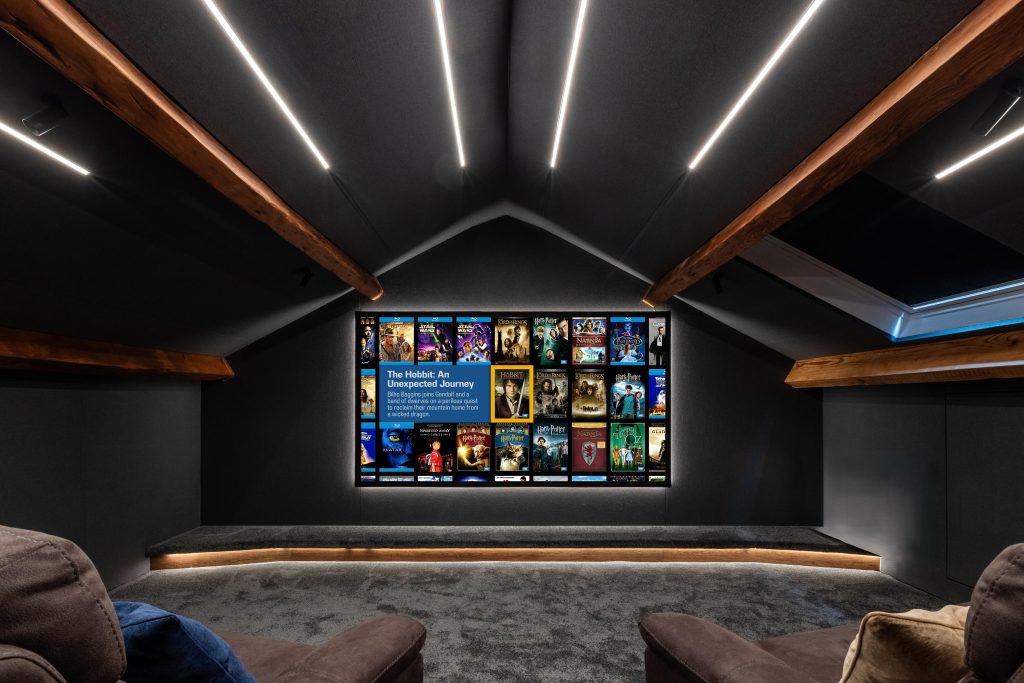
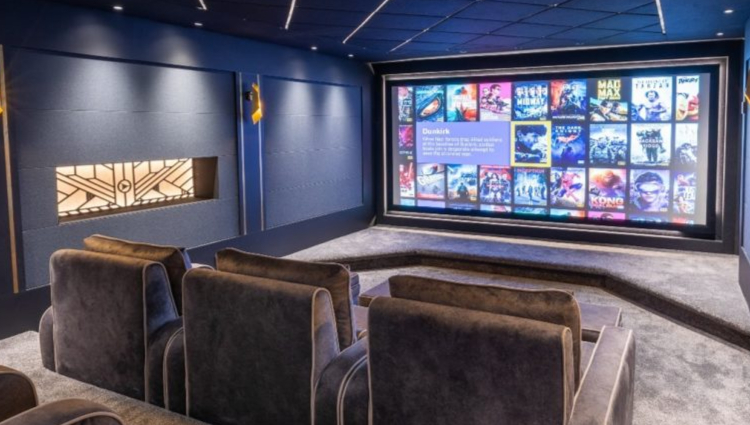
- A reference cinema in a converted outbuilding. A twelve-seat cinema with a 9.4.4 Dolby Atmos system and a 4.5-metre screen, finished with suede wall panelling, illuminated step lighting and a classic starry night fibre optic ceiling. See the reference cinema.
- A rebuilt luxury basement cinema in London. After a flood, we rebuilt a long-standing client’s cinema as a soundproof “room within a room”, with a lacquered double coffer ceiling, linear LED halo lighting and a bespoke fibre optic star sky ceiling. See the luxury basement cinema.
- A Star Wars themed cinema. A compact 7.2.4 Dolby Atmos cinema in an extension, with a starscape ceiling, Lutron blackout blinds and Control4 control as part of a whole-home system. See the Star Wars cinema.
How much does a star ceiling cost?
The cost depends on the area of ceiling, the number and mix of stars, the type of light source and effects, and how the ceiling is built. Every installation is designed for its room, but as a broad guide:
- LED star panels for a small media room or bedroom are the most affordable option, typically from a few hundred to a couple of thousand pounds depending on area.
- A professionally installed fibre optic star ceiling in a typical home cinema usually runs into several thousand pounds.
- Large or highly detailed ceilings, such as fabric-wrapped acoustic star panels with concealed Atmos speakers, dense mixed fibre sizes, constellations or shooting star effects, can cost considerably more.
In a dedicated cinema, the star ceiling is usually a small part of the overall budget. Our guide to how much a home cinema costs shows where it fits.
Can you add a star ceiling to an existing cinema?
Often, yes. Fibre optic star panels can be fitted below an existing ceiling, or ceiling panels can be replaced with star panels. The main considerations are:
- Where existing ceiling speakers sit
- Whether there is space above for the light source and fibre runs
- How the new ceiling will be connected to the lighting control system
A survey will show what is practical in your room.
Frequently asked questions
What is a fibre optic star ceiling?
It is a ceiling with hundreds or thousands of fibre optic strands threaded through it. Each strand ends in a single point of light, and all of them are lit by a light source hidden away from the ceiling. The result is a realistic night sky with no heat or electrics in the ceiling itself.
Do star ceilings work with Dolby Atmos?
Yes, as long as they are designed together. Overhead Atmos speakers can be hidden above an acoustically transparent star ceiling, or set into the ceiling with the star pattern planned around them. The speaker positions should always be fixed first.
Are star ceilings distracting during films?
Not if they are integrated with the lighting control. In a well-designed cinema, the stars fade down or switch off when the film starts, and come back for intermissions and credits.
How long does a fibre optic star ceiling last?
The fibres themselves have no electronics and last many years. The light source is the part that may need servicing or replacing over time. It should be installed somewhere accessible so this can be done without disturbing the ceiling.
Can the stars twinkle or change colour?
Yes. Many light engines offer a gentle twinkle, colour changes or shooting star effects. In a cinema, subtle effects usually work best.
Can I have a star ceiling outside a cinema?
Yes. Star ceilings are also popular in bedrooms, media rooms, games rooms, spas and pool rooms. The materials need to suit the room, for example moisture-resistant systems around pools.
Design your star ceiling with your cinema
A star ceiling looks its best when it is designed as part of the whole cinema: the speakers, acoustics, lighting and interior. Our team designs and builds complete cinema rooms in-house, from the acoustic shell to the final lighting scenes. See our bespoke home cinema service, book a visit to the cinema rooms at our Leeds showroom, or contact our team to talk about your project.