Home Cinema Acoustic Treatment: Where It Goes and Why
Acoustic treatment is what turns a room with good speakers into a cinema that sounds good. Without it, dialogue smears, effects lose their sense of direction and the bass booms in one seat and disappears in the next. With it, the same equipment sounds clearer, more precise and far more convincing.
This guide explains what home cinema acoustic treatment actually does, the three types of treatment and what each one is for, where it belongs on each surface of the room, and the common mistakes we see when treatment has been added without a plan. It is written for homeowners planning a dedicated cinema or improving an existing one.
Acoustic treatment is not soundproofing
The two terms are often used interchangeably, but they solve different problems.
- Acoustic treatment controls how sound behaves inside the room: reflections, echo and bass build-up.
- Soundproofing (acoustic isolation) stops sound getting in or out of the room.
Acoustic panels will not stop the family upstairs hearing an action film, and a perfectly isolated room can still sound poor inside. Most dedicated cinemas need both. This article covers treatment; our home cinema soundproofing guide covers isolation.
What good acoustic treatment achieves
In a well-treated cinema room:
- Dialogue is clear at normal listening levels, without needing to turn the centre channel up
- Sounds come from precise places, so a voice off-screen left sounds like it is off-screen left
- Bass is tight and consistent from seat to seat, rather than boomy in some seats and thin in others
- The room feels larger than it is, with surround and overhead effects blending into one space
- The room is not dead. Over-treated rooms feel oppressive and make the system sound strained
Designers usually express the goal in terms of decay time: how quickly sound dies away after it stops. For a domestic cinema, most aim for a mid-frequency decay time of roughly 0.2–0.4 seconds, kept reasonably even across the frequency range. The CEDIA/CTA RP22 immersive audio guidelines, which many high-end integrators design to, set decay-time targets relative to room size and grade performance across four levels.
The evenness matters as much as the figure itself. A room that is well controlled in the treble but ringing in the bass will still sound muddy.
The three tools: absorption, diffusion and bass trapping
Absorption
Absorbers soak up sound energy rather than reflecting it. They are usually porous materials such as mineral wool, glass wool or polyester fibre, wrapped in acoustically transparent fabric.
Thickness decides what an absorber can control. A thin panel only absorbs high frequencies, and low frequencies pass straight through it. As an approximate guide:
| Absorber | Starts working effectively from |
|---|---|
| 25 mm acoustic foam | around 1,000 Hz |
| 50 mm mineral wool panel | around 500 Hz |
| 100 mm mineral wool panel | around 250 Hz |
| 100 mm panel with a 100 mm air gap behind | around 125 Hz |
Human speech sits mostly between about 250 Hz and 4 kHz, so thin foam leaves much of the dialogue range untouched while stripping out the treble. That imbalance is why rooms treated with thin foam often sound dull and boxy at the same time.
Diffusion
Diffusers scatter sound in many directions rather than absorbing it. They keep energy in the room, preserving a sense of space, while breaking up strong single reflections that would otherwise blur the sound.
Diffusers need distance to work properly. Sitting with your head right next to one produces odd, uneven effects. In most domestic cinemas they work best on the rear wall and the rear half of the side walls, where listeners are at least 2–3 m away.
Bass trapping
Low frequencies are the hardest part of cinema acoustics. Bass wavelengths are several metres long, so they build up into room modes that create peaks and nulls across the seating area. Our guide to home cinema room size and layout explains how room dimensions cause them.
Bass is controlled in three ways, and the best results use all three:
- Deep porous traps in corners and wall-to-ceiling junctions, where bass pressure is highest. Depth is everything: 150–300 mm or more.
- Tuned (membrane or resonant) absorbers, designed to target a specific problem frequency identified by measurement.
- Subwoofer strategy and room correction: using multiple subwoofers in the right positions and then digital correction to smooth what remains. Treatment alone cannot fully fix bass; neither can EQ alone.
Where treatment goes, surface by surface
Front wall
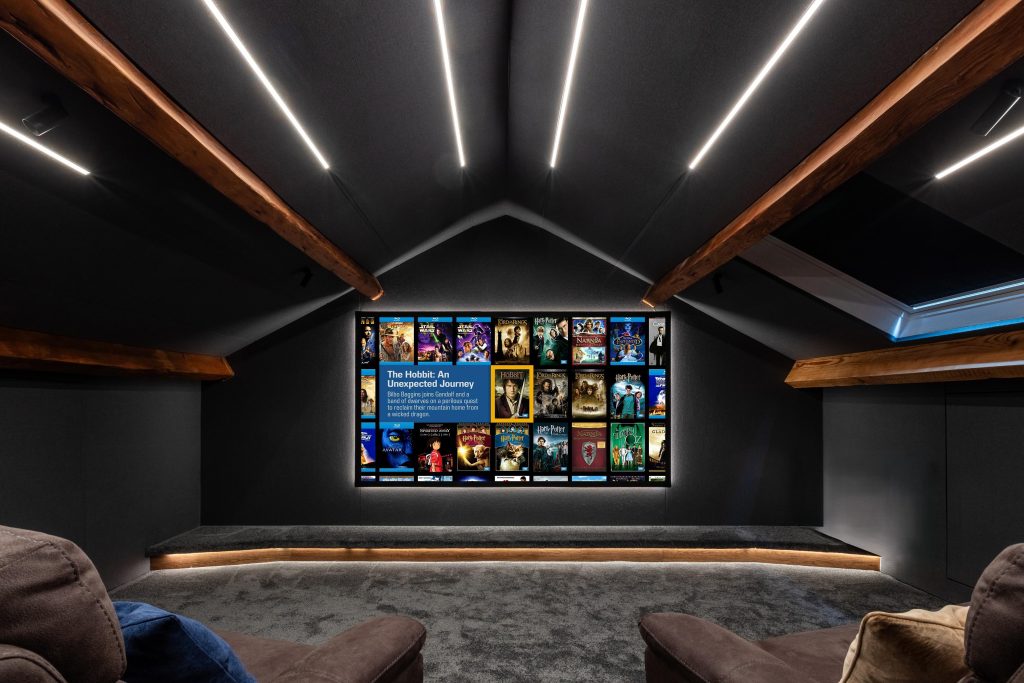
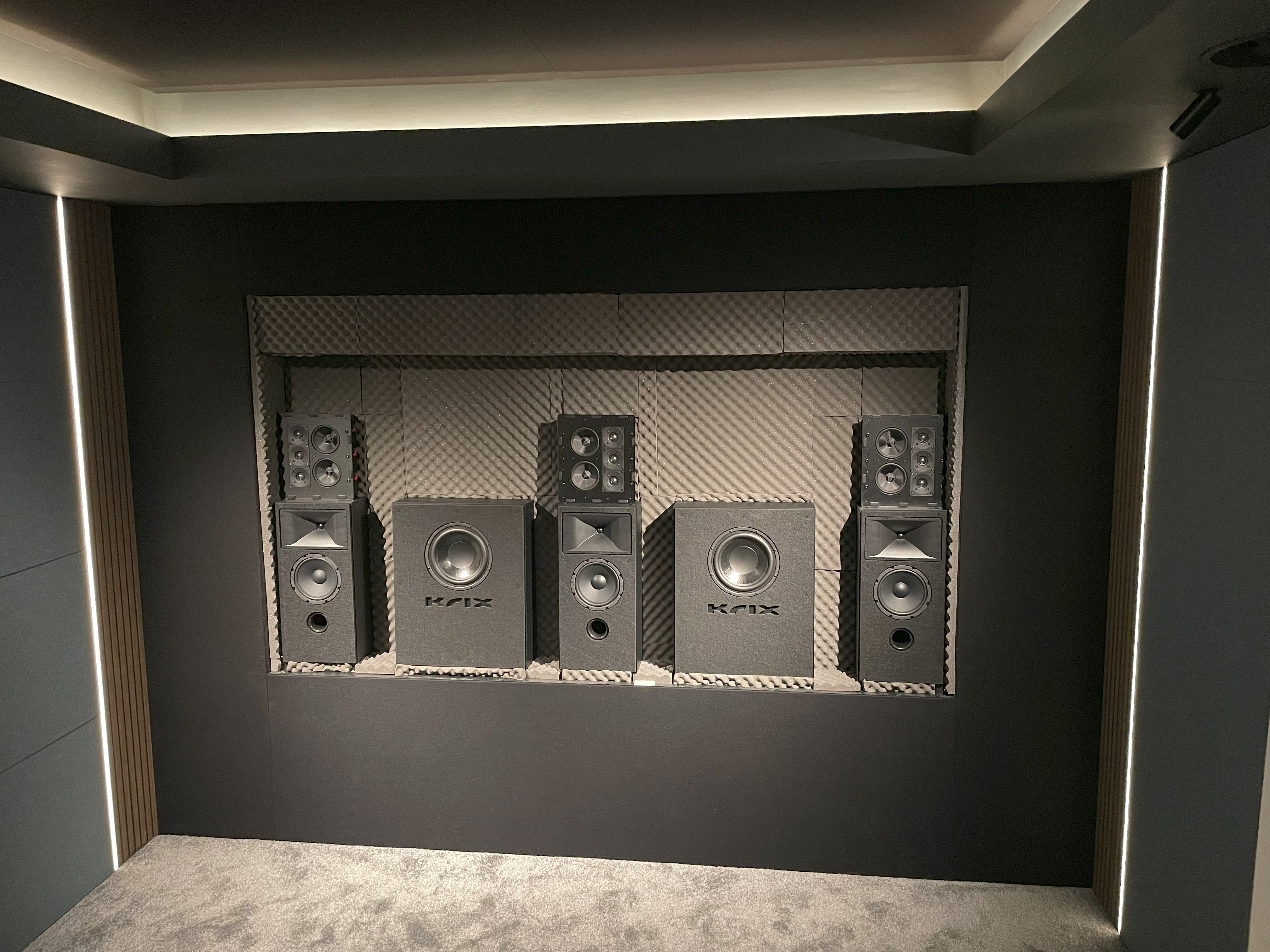
In a dedicated cinema, the wall behind an acoustically transparent screen should be highly absorbent and dark. It stops sound from the front speakers bouncing back through the screen and blurring the image of dialogue, and it stops light spilling back onto the screen. The cavity behind the screen is also one of the best places for deep bass trapping, because it is hidden and usually has the depth.
Side walls and first reflection points
Sound from the front left, centre and right speakers reaches you directly, then a few milliseconds later via reflections off the side walls. Those first reflections are what smear dialogue and blur the stereo image. They are the highest-priority mid and high-frequency treatment in the room.
To find them, sit in the main seat while someone slides a mirror along the side wall. Anywhere you can see a front speaker in the mirror is a first reflection point that needs absorption.
In a Dolby Atmos room, the side walls also carry the surround speakers, so the treatment has to balance two jobs. A common approach is:
- Absorption at the front half of the side walls, covering first reflection points at ear height
- Diffusion or a mix towards the rear half, around and behind the seats, to keep the surround field spacious
Ceiling
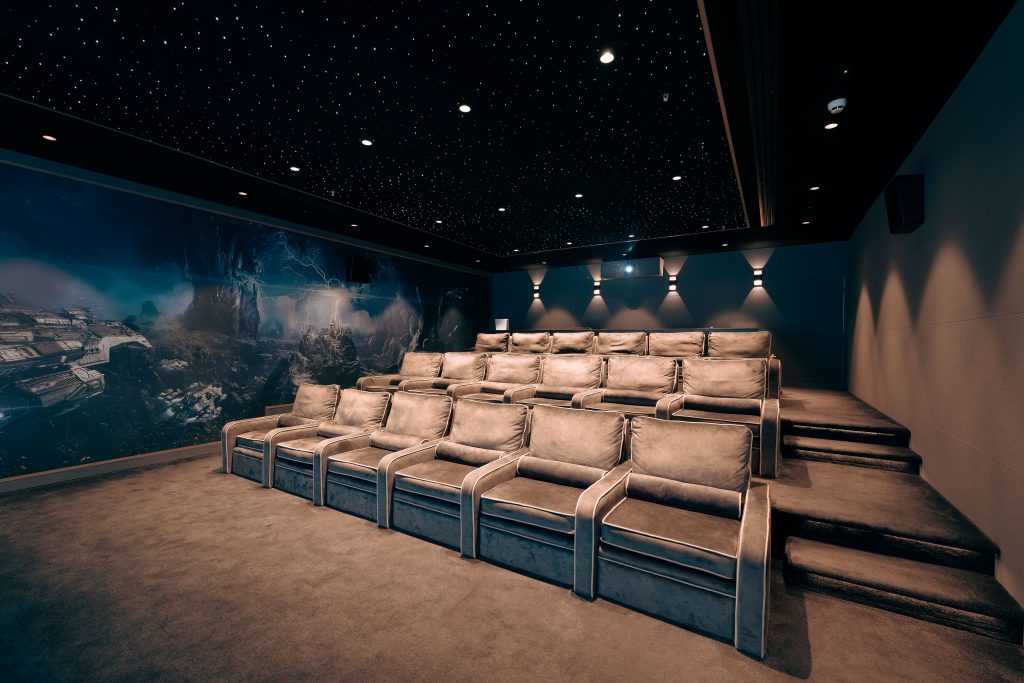
The ceiling produces first reflections just like the side walls, and it is often forgotten. Absorption between the front speakers and the main seats controls those reflections. Overhead Atmos speakers are then mounted within the treated ceiling, often behind acoustic fabric.
Rear wall
What the rear wall needs depends on how close the back row sits to it:
- Back row close to the wall (under about 1.5 m): deep absorption, to stop a strong reflection arriving right behind listeners’ heads
- More space behind the seats: diffusion, which keeps the room lively and helps rear surround effects blend
Floor
Hard floors create a strong reflection between speakers and seats. Carpet with a good underlay across the main listening area is usually enough. In a fully designed room, the riser can also be built as a bass trap: vented at the front and filled with mineral wool, it absorbs bass instead of resonating like a drum.
How much treatment is enough?
There is no fixed percentage of wall area that suits every room. The right amount depends on room volume, construction, furnishings and the number of speakers. Two signs point to getting it wrong:
- Under-treated: hard, bright sound, flutter echo when you clap, dialogue that is hard to follow at moderate volume, and effects that seem to come from the walls rather than from the scene
- Over-treated: a dead, pressurised feel, a sense that the system is straining to fill the room, and surround effects that feel disconnected from the front
The way to avoid both is measurement rather than guesswork, covered below.
Fabric wall systems versus acoustic panels
Acoustic panels
Individual panels and bass traps fixed to existing walls are the usual choice for media rooms, retrofits and smaller cinemas. They are cost-effective, can be positioned precisely at reflection points and are easy to add to later. Good panels are fabric-wrapped mineral wool or polyester, at least 50 mm thick for side walls and 100 mm or more elsewhere.
Stretched fabric wall systems
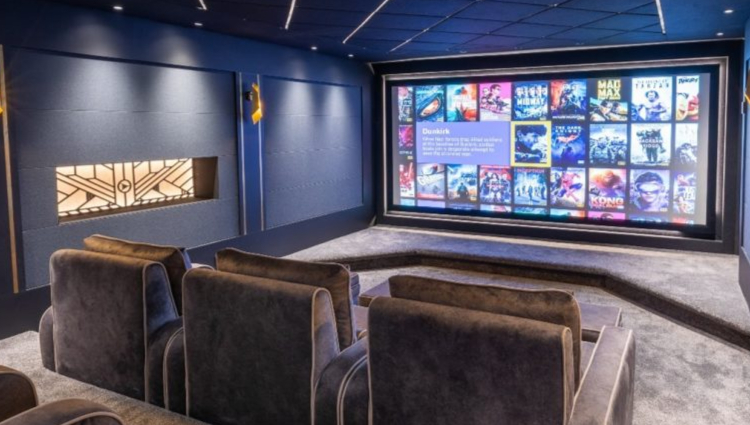
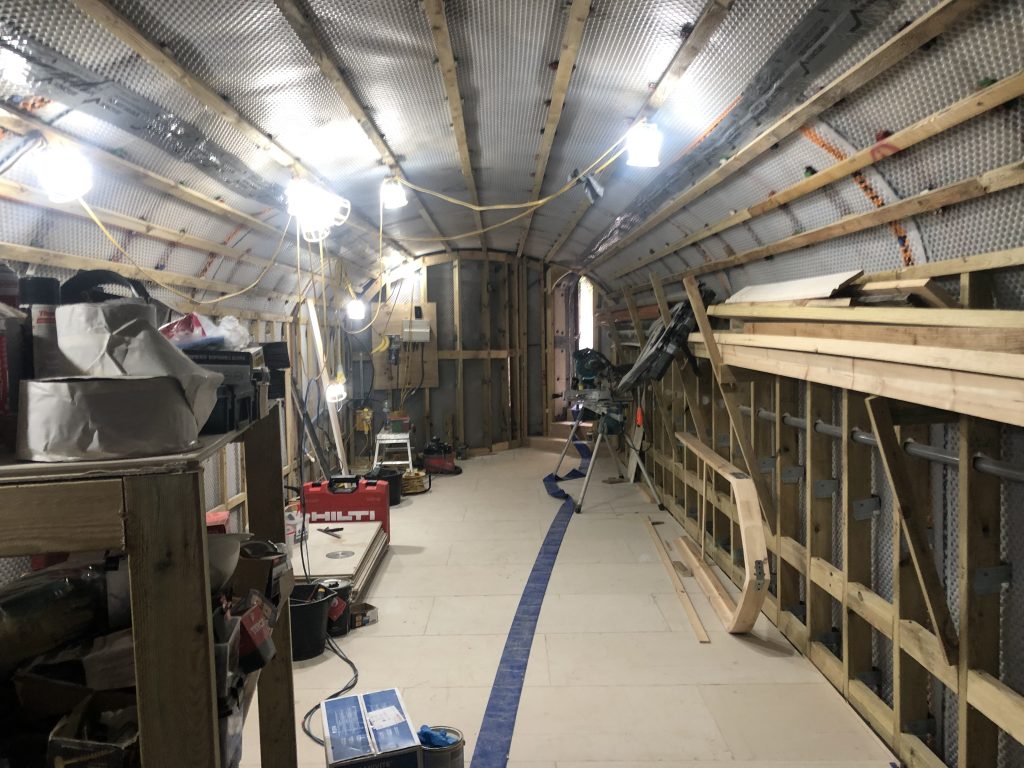
In most dedicated cinemas we design, the walls and ceiling are finished with a stretched fabric wall system. A perimeter track is fixed to the walls, the cavity behind is filled with the right mix of absorption, diffusion and bass trapping for each area, and acoustically transparent fabric is stretched across the face.
The benefits are considerable:
- Treatment can be placed exactly where the acoustic design says, not where panels look tidy
- In-wall speakers, subwoofers and cabling disappear behind the fabric
- Awkward features such as chimney breasts, boxing and uneven walls are hidden behind clean lines
- The room’s interior design is not dictated by the acoustics
Fire safety
Treatment covers a large area of a room that also contains amplifiers, projectors and a lot of cabling, so fire performance matters. Mineral wool infill is typically non-combustible, and fabrics and panels should carry a suitable fire classification (Euroclass or the older Class 0/Class 1 ratings). Cheap open-cell acoustic foam is combustible and is best avoided in large quantities, particularly in a room with a single exit. Always ask a supplier for the fire test certificates.
Common acoustic treatment mistakes
These are the problems we most often find when asked to improve an existing cinema:
- Thin foam tiles on every wall. The treble is absorbed, the bass is untouched and the room ends up both dull and boomy.
- No bass control at all. Mid and high-frequency treatment has been added, but nothing deep enough to affect the 40–150 Hz range where most of the problems live.
- An untreated ceiling. Strong ceiling reflections undo much of the good work on the side walls.
- Seating pushed against the back wall. The back row sits in a bass build-up zone with a hard reflection directly behind their heads.
- Diffusers right beside listeners’ heads. Diffusers need distance to work, and placed too close they create uneven, comb-like colouration.
- Calibration done before the room was finished. Room correction was run, then panels and furniture were added, so the correction no longer matches the room.
- Noisy equipment in the room. Projector fans, amplifier fans and ventilation noise raise the background noise floor and mask quiet detail. Treatment cannot fix what is being generated inside the room.
Measuring the result
Acoustic design should start with a model and finish with measurement. On our projects, measurements are taken at every seat with a calibrated microphone, and typically look at:
- Frequency response at each seat, to see where the bass peaks and nulls sit
- Decay time across the frequency range, to check the room is neither ringing nor dead
- Early reflections, to confirm first reflection points have been dealt with
- Seat-to-seat consistency, so the back row hears what the front row hears
Treatment is adjusted where the measurements show a problem, and only then is the system calibrated. Our home cinema calibration guide explains that final stage.
Acoustic treatment in a media room
Not every room can be fully treated. In a family living space or media room, a lot can still be achieved discreetly:
- Decorative fabric-wrapped panels at the first reflection points, often printed with artwork or matched to the wall colour
- Heavy curtains across glazing, which is one of the most reflective surfaces in a room
- A large rug with underlay between the screen and the seating
- Full, irregular bookshelves, which scatter sound usefully
- Corner bass traps disguised as plinths or joinery
Frequently asked questions
Do I need acoustic treatment in a home cinema?
Yes, for any dedicated cinema. Every untreated room adds reflections and bass problems that make even high-end speakers sound less clear and less precise. Treatment is often the single biggest improvement per pound spent on a cinema’s sound.
What is the difference between acoustic treatment and soundproofing?
Acoustic treatment controls how sound behaves inside the room, reducing reflections and bass build-up. Soundproofing stops sound passing in or out of the room. Treatment will not stop sound leaking to other rooms, and soundproofing will not make a room sound better inside.
Where should acoustic panels go in a home cinema?
Start with the first reflection points on the side walls and ceiling between the front speakers and the main seat, then the front wall behind the screen, then bass traps in the corners. The rear wall is treated with absorption or diffusion depending on how close the back row sits to it.
Are foam acoustic panels good enough for a home cinema?
Thin foam panels only absorb high frequencies, so they leave dialogue and bass problems largely untouched and can make a room sound dull. Fabric-wrapped mineral wool or polyester panels at least 50–100 mm thick perform far better and have better fire ratings.
How much does home cinema acoustic treatment cost?
As a rough guide, good-quality panels and bass traps for a small room start from around £1,000–£3,000 supplied. A fully designed stretched fabric wall system with integrated bass trapping in a dedicated cinema commonly runs from around £8,000 to £25,000 or more installed, depending on room size and finish. Our home cinema cost guide shows how this fits into a full project budget.
Do bass traps really work?
Yes, when they are deep enough and in the right place. Bass traps need significant depth, usually 150 mm or more, and work best in corners and wall-to-ceiling junctions. They are most effective combined with multiple subwoofers and room correction.
Get the acoustics right from the start
Acoustic treatment is far easier and more cost-effective to design in at the start of a project than to add once the room is decorated. Our design team models the room, specifies treatment for each surface, and measures the finished result before calibration, so the cinema performs as designed.
Explore our bespoke home cinema services or request a consultation to discuss your room.