Home Cinema Seating: A Complete Buying Guide
Seating is the part of a home cinema you’re in direct contact with for every minute of every film, yet it’s often chosen last, after the display and sound system have already dictated most of the room’s layout. Getting seating right — comfort, sightlines, spacing, material — is what turns a technically excellent room into one people actually want to sit in for two hours at a time. This guide covers what to consider before choosing cinema seating, and how it connects to the wider room design.
Seating layout: plan it before choosing chairs
The single biggest mistake in seating decisions is choosing the chairs before the layout. Row count, row spacing and riser height should be calculated from the room’s dimensions and the screen size, not decided afterward to fit whatever furniture has already been ordered.
Single-row rooms are simpler to plan, but seating width still needs to be centred correctly on the screen, with the ideal viewing position roughly level with the middle of the screen height.
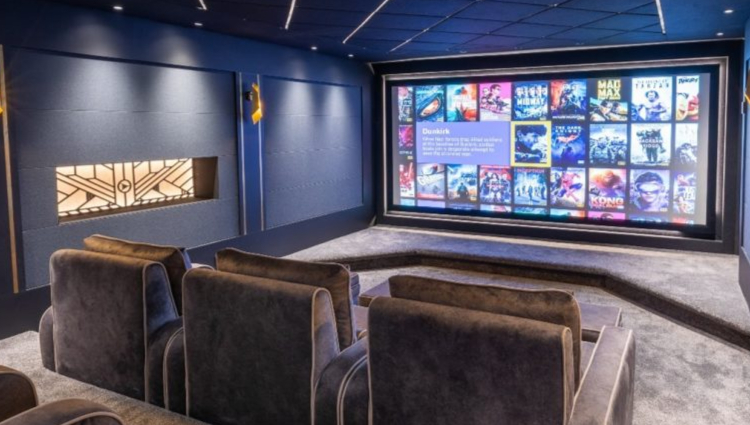
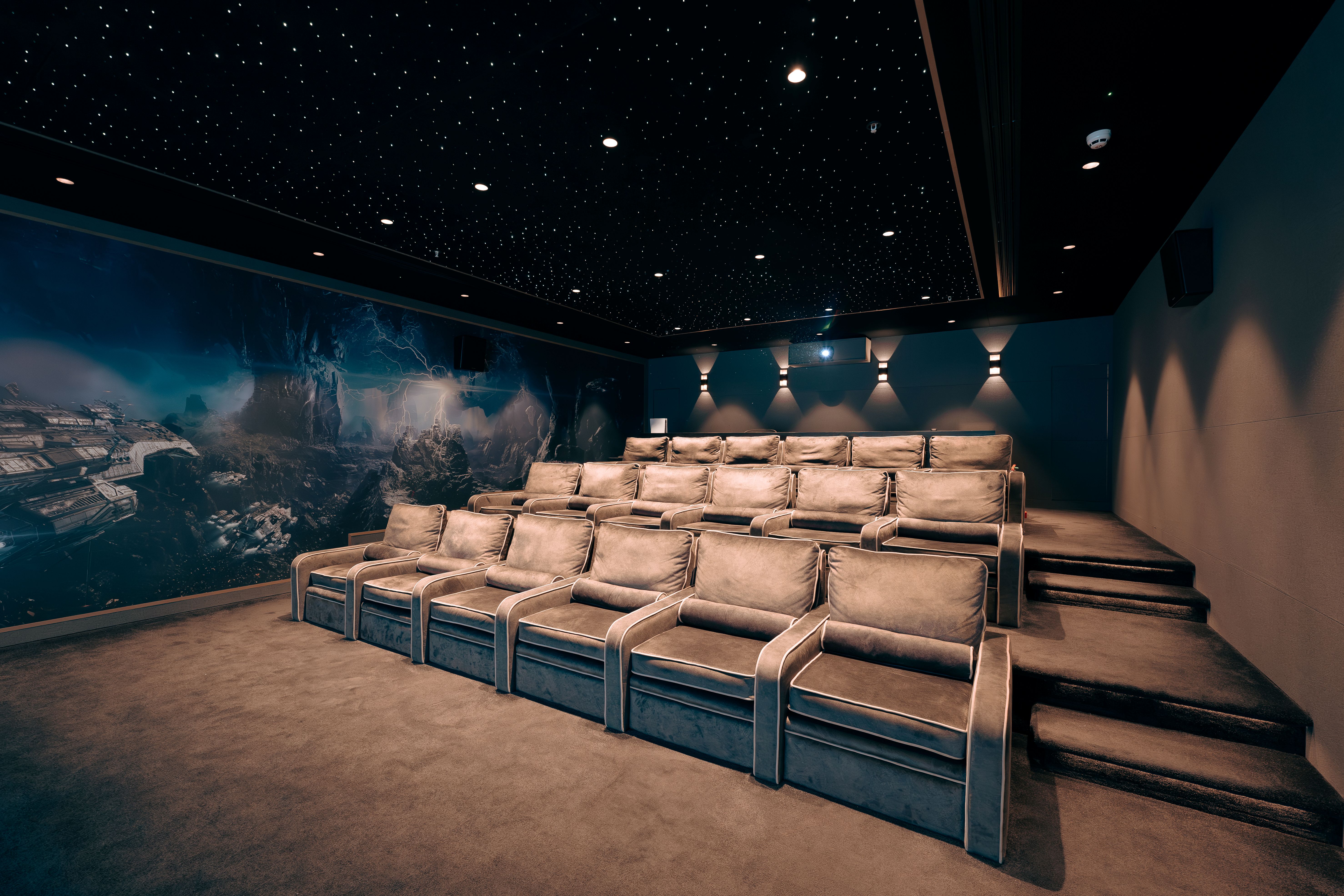
Two-row rooms need a riser for the rear row — without one, rear-row sightlines are compromised by the heads in front, regardless of how good the seats themselves are. A riser of roughly 20–30cm is a common standard, though the correct height depends on seat design, row spacing and the room’s specific proportions, and should be calculated rather than assumed. Row spacing typically allows around 90–100cm behind a fully reclined front-row seat for standard recliners, tighter for wall-hugger designs.
Recliner types
Standard recliners offer the deepest recline and the most generous personal space, but need meaningful clearance behind the seat to recline fully — typically 30–45cm — which affects how tightly rows can be spaced.
Wall-hugger (power-glide) recliners slide the seat forward as it reclines rather than tilting backward, needing as little as 7–12cm of rear clearance. This makes them the practical choice for rooms where space is at a premium, or where a rear-row riser needs to sit close to a back wall.
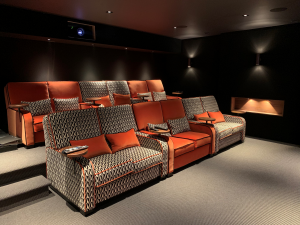
Both mechanisms are available across a wide range of upholstery, from leather through to more contemporary fabric finishes, and can be specified in configurations from single recliners through to multi-seat sofas with integrated recline for each position.
Comfort features worth considering
Powered recline and headrest adjustment allow each seat to be set independently for the person sitting in it, rather than a single fixed position for everyone.
Integrated cup holders, tables and storage keep drinks and remotes off the floor without cluttering the room, and can be specified to match the room’s finish rather than looking like an off-the-shelf add-on.
Heating and massage functions are a genuine comfort upgrade for some households, though worth weighing against the additional cost and mechanical complexity for a feature that sees relatively occasional use.
Bass shakers or haptic feedback, built into some premium seating, add a genuinely immersive, tactile layer to bass-heavy scenes — a feature that connects seating directly to the room’s overall Dolby Atmos and sound design rather than sitting apart from it.
Choosing seating material
Leather remains the most common choice for home cinema seating, for good reason — it’s durable, comfortable, and ages well with normal use. Fabric options have become considerably more sophisticated in recent years and offer a wider range of colours and textures, worth considering where the room’s interior design calls for something beyond the traditional cinema look. Either way, seating should be chosen to match the room’s wider aesthetic — a fully bespoke cinema room loses some of its impact if the seating looks generic against a considered interior scheme.
Lighting and seating position
Perimeter, low-level lighting rather than overhead downlights is the standard approach around cinema seating, avoiding glare and reflections on the screen while still providing enough light for safe movement and finding a seat. Aisle or step lighting, built discreetly into riser edges, is a small but genuinely valuable detail for two-row rooms, addressed properly in our cinema lighting and mood design guide.
Bespoke vs off-the-shelf cinema seating
Off-the-shelf cinema seating ranges are a genuinely reasonable option for many projects, offering a wide choice of configurations at a range of price points. Where a room has unusual proportions, a specific interior design brief, or a client wanting something that doesn’t look like every other cinema room, fully bespoke seating — custom dimensions, upholstery and finish — becomes the better option, generally at a higher cost but with a result properly matched to the room rather than fitted around it.
Frequently asked questions
How much space do I need behind a cinema recliner? Standard recliners typically need 30–45cm of clearance to recline fully. Wall-hugger recliners need considerably less, often 7–12cm, making them the practical choice for space-constrained rooms or rear-row risers positioned close to a back wall.
Do I need a riser for a two-row cinema room? Yes, in almost all cases. Without a riser, rear-row sightlines are compromised by the seating in front, regardless of seat quality. Riser height should be calculated from the room’s specific dimensions and seating choice, though 20–30cm is a common starting point.
What’s the difference between wall-hugger and standard recliners? Standard recliners tilt backward and need more rear clearance to recline fully. Wall-hugger recliners slide forward as they recline, needing much less rear clearance, making them better suited to tighter spaces.
Should I choose seating before or after the room layout is designed? After, ideally alongside it. Row spacing, riser height and seating width should be calculated from the room’s dimensions and screen size first, with seating selected to fit that layout, rather than choosing furniture and working the room design around it.
Is bespoke cinema seating worth the extra cost over off-the-shelf options? For rooms with unusual proportions or a specific interior design brief, bespoke seating delivers a result properly matched to the room, generally at a higher cost. Off-the-shelf ranges remain a genuinely strong option for many standard-proportioned rooms.
Specify seating for your room, properly
Cinema seating works best when it’s planned as part of the whole room design, not chosen last. Explore our dedicated home cinema seating service, our bespoke home cinema design guide, or get in touch to discuss layout and seating options for your project.