Home Cinema Soundproofing: The Room-Within-a-Room Guide

Soundproofing is the part of a home cinema project that’s least visible in the finished room and most responsible for whether the room actually works. A cinema with a flagship projector and a full Dolby Atmos system will still disturb the rest of the house — or let outside noise bleed in and ruin dialogue — if the room itself hasn’t been properly isolated. This guide explains what genuine soundproofing involves, why acoustic panels alone don’t solve it, and what to expect at different budget levels.
Why soundproofing is different from acoustic treatment
These two things are often confused, but they solve different problems. Acoustic treatment — panels, bass traps, diffusers — controls how sound behaves inside the room, improving clarity and reducing unwanted reflections. Soundproofing — also called acoustic isolation — stops sound getting in or out of the room at all. A cinema can have excellent acoustic treatment and still be poorly soundproofed, disturbing bedrooms above or neighbouring rooms every time the sub-bass kicks in. Both are needed; neither substitutes for the other. Our bespoke home cinema design guide covers acoustic treatment in more depth — this article focuses specifically on isolation.
The room-within-a-room principle
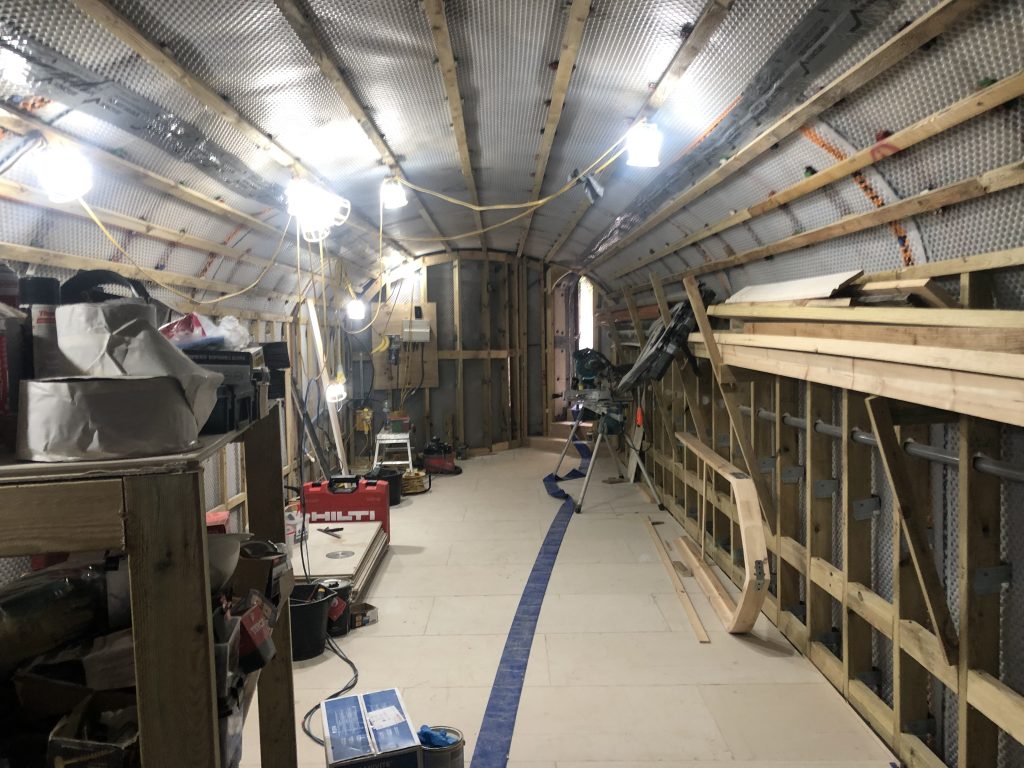
The gold standard for cinema soundproofing is a “room within a room” — sometimes called a box-in-box construction — where an internal structure is built that is physically decoupled from the surrounding building. Rather than sound simply being absorbed, it has nowhere to transfer to, because the cinema’s walls, ceiling and floor aren’t rigidly connected to the rest of the house’s structure.
This decoupling is achieved through a combination of resilient bars or independent isolation clips, mass-loaded acoustic barriers, and air gaps between the inner and outer structure. Low-frequency bass — the hardest sound to contain, and the most disruptive to the rest of a house — travels through solid structural connections far more readily than through air, which is why simply adding foam panels to an existing room’s walls rarely solves a genuine noise problem.
Where soundproofing matters most
Floors, when the cinema sits above another room. Impact and airborne noise transfer downward more readily than most homeowners expect, particularly with a subwoofer running. A floating floor — decoupled from the joists below — is typically the single highest-value soundproofing investment for a first-floor or upper-level cinema.
Walls shared with bedrooms or neighbouring properties. An independent wall lining, built using isolation clips and mass-loaded board rather than simply thicker plasterboard, is the standard approach where a cinema wall backs onto a room that needs to stay quiet.
Ceilings, where a cinema sits beneath a bedroom or living space above. The same decoupled principle applies — a floating ceiling structure, rather than acoustic tiles fixed directly to existing joists.
Doors and any penetrations. A cinema built to an excellent soundproofing standard everywhere except the door will still leak sound through that single weak point. Acoustic door seals, solid-core doors, and in higher-specification projects, dedicated acoustic doors, close this gap.
What genuinely can’t be fixed with panels alone
This is worth being explicit about, because it’s the most common expectation gap we encounter: foam or fabric acoustic panels absorb mid and high-frequency reflections inside a room, improving clarity and reducing echo — but they do very little to stop low-frequency bass transferring through a shared structure to the rest of the house. If the goal is “the room next door shouldn’t hear the film”, that’s a soundproofing and decoupling problem, not an acoustic panel problem, and needs to be addressed at the build stage rather than retrofitted afterwards with surface treatments.
Retrofit vs new-build soundproofing
In a new build or major renovation, soundproofing can be planned into the room’s construction from the outset — floating floor, independent walls and ceiling built as part of first-fix, at a cost considerably lower than achieving the same result after the room is finished. This is the point at which involving a cinema designer alongside the architect and builder pays for itself many times over.
In a retrofit — converting an existing room into a cinema — soundproofing is still achievable but more disruptive and typically more expensive per square metre, since existing surfaces need to be removed or built out from, reducing usable floor and ceiling space in the process. It remains worth doing properly rather than skipped, since a cinema that disturbs the rest of the household every evening is rarely used to its potential.
Typical costs
Soundproofing costs vary considerably depending on how many surfaces need treating and whether the project is new-build or retrofit. As a rough guide, a genuinely well-isolated single-wall independent lining typically starts from around £150–£250 per square metre installed, with a full room-within-a-room treatment (floor, walls and ceiling) for a mid-sized cinema commonly representing a meaningful proportion of the overall project budget. See our home cinema cost guide for how this fits into total project costs.
Frequently asked questions
What’s the difference between soundproofing and acoustic treatment? Soundproofing (acoustic isolation) stops sound transferring in or out of a room, typically through decoupled, room-within-a-room construction. Acoustic treatment (panels, bass traps, diffusers) controls how sound behaves inside the room once it’s there. Both are needed for a cinema that sounds good and doesn’t disturb the rest of the house.
Can acoustic panels alone soundproof a home cinema? No. Acoustic panels absorb reflections and improve clarity inside the room, but they do very little to stop low-frequency bass transferring through walls, floors and ceilings to adjoining rooms. Genuine soundproofing requires decoupled, isolated construction.
Is it more expensive to soundproof a retrofit cinema than a new build? Generally yes, per square metre, because a retrofit involves removing or building out from existing surfaces, whereas a new build can have soundproofing planned into the construction from first-fix, which is more cost-effective and less disruptive.
Does a basement or garage cinema need less soundproofing? Basements and garages often benefit from being naturally more isolated from the rest of the house, but shared walls, ceilings and any rooms directly above still need proper treatment, particularly if the space is being converted from an unconverted shell rather than built from scratch as a cinema.
How much does home cinema soundproofing cost? An independent wall lining typically starts from around £150–£250 per square metre installed, with full room-within-a-room treatment representing a significant proportion of total project cost for a dedicated cinema, depending on room size and how many surfaces need treating.
Get soundproofing right from the start
Soundproofing is far easier and more cost-effective to plan in at the design stage than to retrofit later. If you’re planning a new cinema room, our team can design the acoustic isolation alongside the rest of the build. Explore our bespoke home cinema services or get in touch to discuss your project.